

National Cake Day: From Storybooks to Sweet Little Adventures
There is something magical about a cake.
Maybe it's the moment little hands begin mixing imaginary ingredients, the excitement of choosing colorful decorations, or the anticipation of sharing something delicious with others. Cakes are part of so many childhood memories: birthdays, family gatherings, afternoons in the kitchen, and stories that bring wonderful characters together.
A cake can be a celebration, a gift, a reason to gather, or the beginning of an unexpected adventure.
And in children's books, cakes often become much more than something to eat. They inspire characters to solve problems, work together, make decisions, and discover the joy of creating something for someone else.
On November 26, National Cake Day, we have a lovely opportunity to bring stories, language, early math, sensory exploration, and imaginative play together through one familiar theme.
You don't need a real cake, an elaborate baking project, or an entire day of planned activities. Sometimes, a favorite picture book, a few simple props, and an invitation to pretend are enough to begin.
Whether you're sharing stories at home, in a daycare, at the library, or in an early years learning environment, National Cake Day offers countless possibilities for meaningful, playful learning.
Let's explore how a simple cake can inspire so much more than a celebration.
Why National Cake Day Is a Wonderful Learning Opportunity
Young children are naturally drawn to familiar experiences. They enjoy pretending to cook, serving imaginary meals, organizing little tea parties, and recreating the routines they observe in everyday life.
A cake provides a familiar starting point for exploring new ideas.
Children can count candles, compare sizes, talk about ingredients, describe colors, create patterns, and invent stories about who will bake the cake and why.
They can also explore social concepts such as sharing, cooperation, generosity, and celebrating special moments with others.
Through simple, playful experiences, children can develop:
Language and vocabulary: Learning words related to baking, ingredients, tools, flavors, and celebrations.
Early literacy: Listening to stories, recognizing repeated phrases, retelling events, and exploring sequencing.
Early math: Counting, sorting, comparing quantities, measuring, and creating patterns.
Fine motor skills: Rolling, pinching, cutting, decorating, scooping, and manipulating materials.
Creative thinking: Designing cakes, inventing recipes, and imagining new possibilities.
Social-emotional skills: Sharing materials, taking turns, collaborating, and creating something for others.
Sensory awareness: Exploring textures, colors, shapes, and the properties of different materials.
The goal isn't to teach every skill through a single activity. It's to recognize the possibilities within a familiar theme and allow children to explore them naturally.
Read-Aloud Books for National Cake Day
Books are a wonderful starting point for a cake-themed exploration. They introduce characters, vocabulary, problems, and sequences while giving children something meaningful to revisit through play.
Here are several picture books to add to your reading basket.
A Piece of Cake by LeUyen Pham
Mouse wants to make a birthday cake for Little Bird, but his plans lead to a series of unexpected events. The story offers opportunities to explore friendship, problem-solving, generosity, and the different ways we try to help others.
After reading: Invite children to create a pretend birthday cake for someone special. Who is the cake for? What decorations would they choose? How could they make the celebration meaningful?
Marigold Bakes a Cake by Mike Malbrough
Marigold is a cat who loves baking cakes and carefully plans his Monday baking routine. But when unexpected visitors interrupt his peaceful kitchen, things don't go quite as planned. This humorous story offers opportunities to explore sequencing, problem-solving, following routines, and what happens when things don't go according to plan.
After reading: Invite children to set up a pretend bakery with mixing bowls, wooden spoons, and play dough. What kind of cake would they bake? What ingredients would they need? What might happen if unexpected visitors arrived in their kitchen?
Cook-a-Doodle-Doo! by Janet Stevens and Susan Stevens Crummel
Big Brown Rooster and his friends decide to make a strawberry shortcake, discovering that baking involves more than simply mixing ingredients. Their adventure introduces cooking vocabulary, measuring, following directions, and working together.
After reading: Set up a pretend baking station with bowls, measuring cups, spoons, and play dough. Children can recreate the baking process, invent their own recipes, and explore the tools used in the kitchen.
The Little Red Hen Bakes a Cake by Dianne de Las Casas
This retelling of a familiar folktale provides a starting point for conversations about baking, responsibility, cooperation, and the sequence of a recipe.
After reading: Invite children to retell the story using puppets or picture cards. What happened first? What did the hen need? What happened when the cake was ready?
The Cake That Mack Ate by Rose Robart
This cumulative story follows a series of events connected to a cake that Mack eats. Its predictable structure makes it a useful choice for exploring repetition, memory, sequencing, and the relationships between characters and events.
After reading: Create a simple story sequence using pictures or homemade props. Invite children to reconstruct the story and anticipate what might happen next.
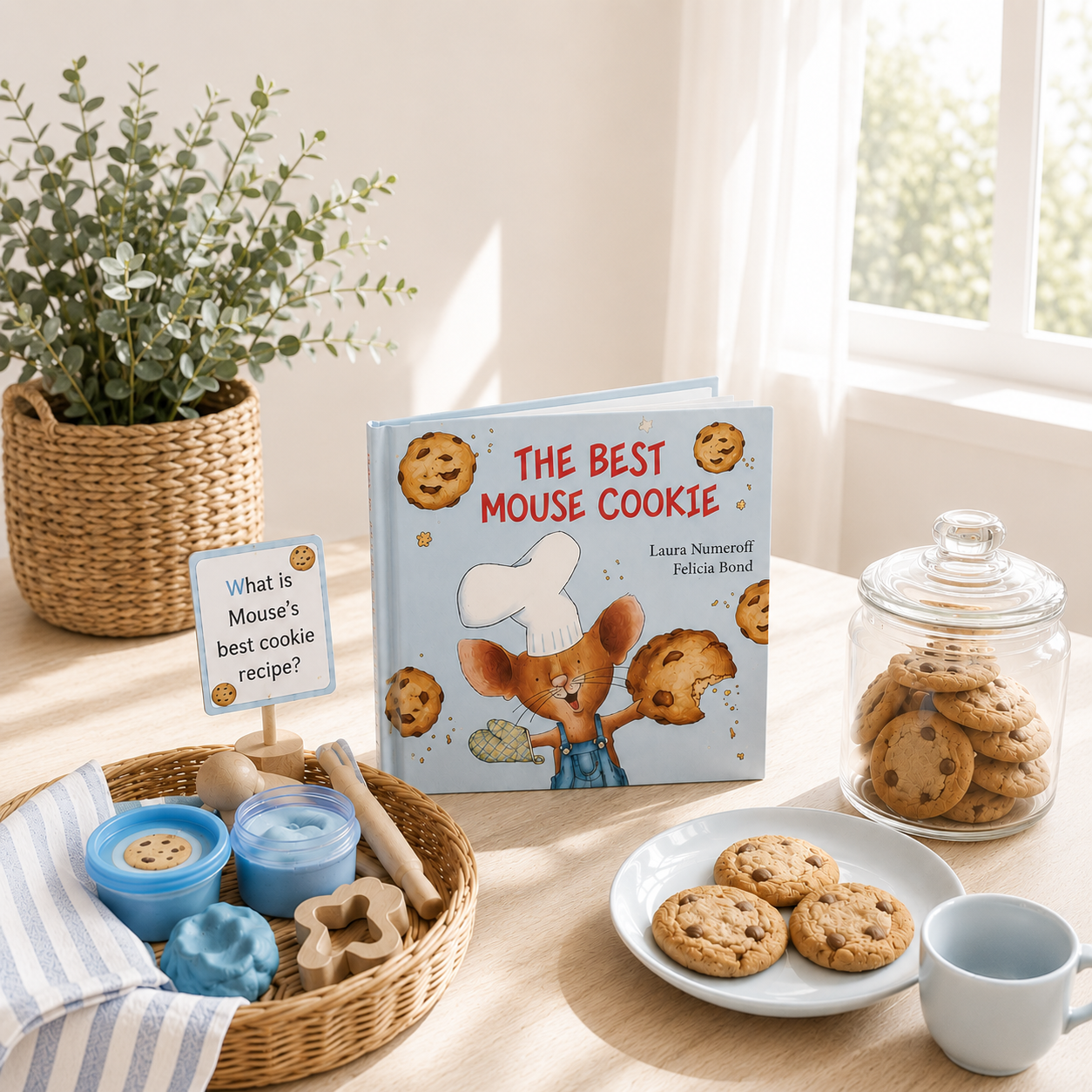
If You Give a Mouse a Cookie by Laura Numeroff
Although this story focuses on a cookie rather than a cake, it is a lovely companion read for exploring baking, food, cause and effect, and the way one event can lead to another.
After reading: Ask children to imagine what might happen if a mouse were given a piece of cake. What would he ask for next? Their answers can become the beginning of a new story.
Baking Day at Grandma's by Anika Denise
This warm story follows a child and grandmother baking together, offering opportunities to talk about family traditions, spending time together, and the pleasure of making something with another person.
After reading: Create a pretend family bakery with aprons, mixing bowls, recipe cards, and play food. Invite children to share their own experiences of cooking or baking with family members, if they wish.
A little reading tip: You don't need to read every book in one day. Choose one story, revisit it over several days, and allow the children to become familiar with its characters and events. Repeated reading often creates the strongest connections between a story and subsequent play.
From Story to Play: Creating a Pretend Bakery
One of the easiest ways to extend a cake story is to create a small pretend bakery.
You don't need a complete play kitchen. A small table, a few containers, and some thoughtfully chosen materials can become a wonderful invitation to play.
What You Need
Mixing bowls and wooden spoons.
Measuring cups and scoops.
Play dough.
Empty cake boxes or small cardboard boxes.
Paper cake decorations.
Reusable plates and trays.
Notepads and pencils for taking orders.
Simple picture menus.
Aprons or fabric pieces.
Arrange the materials so children can access them independently.
Some may begin mixing imaginary batter. Others may create a display of cakes, write orders, or organize a pretend celebration.
Allow the play to develop without assigning every child a role.
Learning Through the Bakery
As children play, introduce language naturally.
You might ask:
What are you making today?
How many cakes do you have?
Which cake is the biggest?
What ingredients do you need?
Who would you like to invite?
How much will the cake cost?
What happens after the cake goes into the oven?
These questions encourage children to explain their thinking, experiment with ideas, and use language in meaningful contexts.
For English language learners, the bakery also offers opportunities to practice familiar expressions:
I would like a cake, please.
Here you are.
Thank you.
Let's mix the ingredients.
It's time to decorate!
There is no need to turn pretend play into a formal language exercise. Model useful expressions, respond to children's ideas, and let the conversation unfold.
Cake Decorating With Play Dough
Play dough is a wonderful material for exploring a cake theme without the need to prepare food.
Offer several colors of play dough, rolling pins, large cutters, and age-appropriate decorating materials.
Children can create layers, roll imaginary frosting, shape candles, and design cakes for different occasions.
You might introduce a few simple challenges:
Can you make a cake with three layers?
Can you create a cake with two colors?
How many candles would you like to add?
Can you make one cake bigger than another?
What could you create for a birthday party?
Some children will follow the suggestions. Others will invent their own designs.
Both approaches are valuable.
The activity encourages fine motor development, spatial awareness, creativity, and descriptive language while allowing children to work at their own pace.
Early Math: Counting, Sorting, and Measuring
A cake-themed invitation can make early math feel natural and playful.
Instead of presenting isolated exercises, incorporate mathematical ideas into the bakery experience.
Count the Candles
Provide paper cakes and removable paper candles.
Children can count candles, match quantities, or add another candle when the imaginary baker announces a new birthday.
Sort the Decorations
Offer large counters or paper shapes in different colors.
Children can sort them by color, size, or shape and use them to decorate their pretend cakes.
Create Patterns
Invite children to arrange two or three colors in a repeating sequence.
For example:
Red, yellow, red, yellow.
Older children might invent their own patterns and explain what comes next.
Compare Cake Sizes
Provide paper circles or play dough cakes of different sizes.
Talk about big and small, tall and short, more and less.
Ask children to compare their creations and describe what they notice.
Explore Measuring
During pretend baking, offer measuring cups and spoons.
Children can fill, empty, compare, and experiment with quantities, discovering how different tools can hold different amounts.
The emphasis should remain on exploration and mathematical language, rather than on producing identical results.
Literacy Invitations: Recipes, Menus, and Storytelling
The pretend bakery can become a rich environment for early literacy.
Children don't need to be independent readers or writers to participate. Drawing, making marks, dictating words, and exploring printed materials are all meaningful parts of early literacy development.
Try these simple invitations:
Create a bakery menu. Offer paper, pencils, and pictures of different cakes. Children can draw their products, invent names, and dictate descriptions.
Write an imaginary recipe. Invite children to draw the ingredients they would use to make their favorite cake. An adult can write down their words.
Make a shopping list. What would the baker need? Children can draw or mark the items they want to collect.
Retell a baking story. Use picture cards or props to represent the beginning, middle, and end of a familiar book.
Invent a new cake story. Ask children to imagine a cake with a special power. Does it make people laugh? Does it change colors? Who discovers it?
These activities connect literacy with purposeful communication and imaginative thinking.
Sensory Exploration: What Goes Into a Cake?
Baking involves many interesting textures, materials, and transformations.
You can explore these ideas through sensory play without needing to prepare a real recipe.
Set out a tray with bowls, scoops, measuring cups, and a selection of safe materials such as large pom-poms, fabric pieces, or play dough.
Invite children to scoop, transfer, mix, and arrange the materials as they create imaginary cakes.
If you choose to explore real ingredients, such as flour or sugar, consider allergies, sensitivities, and the possibility of accidental ingestion. Use close supervision and age-appropriate materials.
You can also create a simple observation invitation using photographs of baking ingredients.
Ask:
What do you notice?
Which ingredients look similar?
What do you think would happen if we mixed them?
How might the ingredients change when heated?
Children can make predictions and describe their observations without needing to conduct a complicated experiment.
The focus is curiosity, exploration, and the pleasure of noticing.
A Little Real Baking, Too
If you have access to a kitchen and the opportunity to bake together, a simple recipe can become a meaningful shared experience.
Children can help measure ingredients, count spoonfuls, stir the mixture, and observe how the batter changes.
They can notice differences in texture, color, smell, and consistency.
You might introduce words such as mix, pour, stir, measure, batter, flour, and bake as you work.
Talk about the sequence of events:
First, we gather the ingredients.
Next, we mix them together.
Then, an adult puts the cake in the oven.
Finally, we wait for it to cool before decorating or serving it.
Cooking can also provide opportunities to talk about patience, cooperation, and caring for others.
Always supervise children around utensils, ingredients, and hot equipment. Check allergies and dietary requirements, and ensure that children do not eat raw batter containing ingredients that should not be consumed uncooked.
And remember: real baking is optional. Pretend play can offer many of the same opportunities for language, mathematical thinking, and creativity.
Art Invitations: Designing Cakes
Cake decorating can inspire wonderful opportunities for creative expression.
Provide paper circles, crayons, colored pencils, collage materials, and child-safe glue.
Invite children to design a cake for a special occasion.
It might be a birthday cake, a cake for a favorite story character, or a completely imaginary creation.
Encourage them to think about colors, shapes, patterns, and decorations.
You might ask:
Who is the cake for?
What makes this cake special?
What would you call it?
How many layers does it have?
What story could happen around this cake?
Children can share their creations with the group or dictate a short description to accompany their artwork.
There is no need for every cake to look the same. The purpose is to give children a chance to make choices, express ideas, and communicate through art.
Social-Emotional Learning: The Joy of Sharing
Cakes often appear in stories about birthdays, family gatherings, celebrations, and friendship.
This makes National Cake Day a natural opportunity to explore the idea of sharing something with others.
After reading a story about baking, invite children to imagine making a cake for someone special.
Who would they choose?
What kind of cake might that person enjoy?
How could they make the celebration meaningful?
Children might create a pretend cake for a friend, draw a picture for a family member, or work together to decorate one large paper cake.
These activities can open gentle conversations about generosity, thoughtfulness, and the pleasure of doing something for another person.
Sharing should be encouraged without forcing children to give away personal belongings or food. The emphasis is on exploring kindness and considering others.
Quick Moments or Deeper Exploration?
Not every special day needs an elaborate plan.
Sometimes, a short read-aloud followed by a few minutes of pretend baking is enough.
You might read a favorite story, bring out play dough, and let children create their own cakes before moving on to the next part of the day.
On another occasion, the same theme might grow into a longer exploration.
Children may spend the morning creating a bakery, making menus, counting decorations, inventing recipes, and developing stories around their creations.
Both experiences have value.
A quick invitation can spark curiosity, while a longer exploration allows children to revisit ideas, solve problems, and develop their play.
This is one of the things I love about a slower, more intentional approach to learning: recognizing when a small moment is enough and when children's curiosity invites us to stay a little longer.
We don't have to do everything.
We can choose one meaningful story, prepare a few materials, and allow the children to guide what happens next.
Creating a Cake-Themed Learning Basket
If you enjoy having simple invitations ready to use, consider putting together a small cake-themed basket.
Include:
One or two picture books about baking.
A few mixing bowls and wooden spoons.
Play dough and a rolling pin.
Large, age-appropriate decorating materials.
Paper circles for designing cakes.
Picture cards showing baking steps.
A small notebook for imaginary recipes.
Pretend plates and trays.
Keep the basket accessible and bring it out when the children show interest.
You can rotate the books, introduce new props, or connect the materials with another story.
The same basket might inspire a bakery one day, a birthday celebration the next, and a completely imaginary cake-making adventure later in the week.
You don't need to prepare a new activity every time. Familiar materials often become more interesting as children discover new ways to use them.
Connecting Cake Day With Other Learning Experiences
A cake theme can connect naturally with other areas of learning.
A story about baking can lead to a discussion about ingredients and where food comes from.
A pretend bakery can inspire counting, sorting, and simple money play.
A recipe can introduce sequencing and procedural language.
A cake design can lead to conversations about shapes, colors, patterns, and creative choices.
And a story about making a cake for someone else can open the door to conversations about friendship, generosity, and family traditions.
These connections don't need to be planned as separate lessons.
Often, they emerge naturally when children have time to explore an idea from different perspectives.
Follow their questions. Notice what captures their attention. Offer another material or revisit a familiar book when it feels meaningful.
Learning becomes richer when children can make connections between stories, play, and the world around them.
A Sweet Little Reminder
National Cake Day is a lovely excuse to slow down, open a storybook, and make room for a little imaginative play.
You don't need a perfect bakery setup, a complicated recipe, or a long list of activities.
A favorite read-aloud, a few simple props, and an invitation to create can be enough to begin.
Let children mix imaginary ingredients, design impossible cakes, invent recipes, and tell stories about the people who might enjoy their creations.
Some will count candles. Others will spend an entire morning decorating a play dough cake. Someone might invent a story about a cake that takes children to the moon.
Give those ideas room to grow.
Because sometimes, the most meaningful learning experiences begin with something wonderfully ordinary.
A story. A little play. And a cake made entirely from imagination.


0 Comments:
Post a Comment
Thanks for your comment!