

Some picture books help children learn new words.
Others help children understand the world around them.
And then there are books that give children something they can use every day: a way to talk about their feelings.
The Color Monster by Anna Llenas introduces children to a little monster who wakes up feeling confused because all of his emotions seem to be mixed together.
With the help of a friend, he begins to sort his feelings and give each one a color.
Yellow for happiness.
Blue for sadness.
Red for anger.
Black for fear.
Green for calm.
Pink for love.
What begins as a story about a mixed-up monster becomes a beautiful invitation for children to stop, notice what they are feeling, and begin putting words to those feelings.
And that is what makes The Color Monster such a wonderful book for early childhood classrooms.
It gives children a simple visual language for something that can sometimes be very difficult to explain:
How am I feeling?
What Is The Color Monster About?
The Color Monster follows a little monster who doesn't quite understand what is happening inside him.
His emotions are all mixed together.
He feels confused and overwhelmed, and he needs help figuring them out.
A friend encourages him to separate his feelings and place each emotion into its own color.
As the story progresses, children are introduced to different emotions through color:
- Yellow represents happiness.
- Blue represents sadness.
- Red represents anger.
- Black represents fear.
- Green represents calm.
- Pink represents love.
Instead of treating emotions as something children should simply "get over," the story gives them names, colors, and visual representations.
That makes abstract feelings much easier for young children to understand.
Children can begin to recognize that feelings are different from one another—and that all feelings are part of being human.
The story also creates an opportunity to talk about something important:
Sometimes we experience several emotions at once.
Sometimes we don't immediately know what we are feeling.
And sometimes we need a little help identifying and organizing those feelings.
Why Children Connect with This Story
Young children experience big emotions every day.
They can feel happy one minute and frustrated the next.
They may be excited about a birthday party but nervous about going somewhere new.
They may miss someone they love while also having fun with their friends.
For young children, identifying these feelings isn't always easy.
They might say:
"I don't know."
Or:
"I'm mad!"
when what they are really experiencing is disappointment, frustration, embarrassment, sadness, or even fear.
The Color Monster gives children a visual starting point.
Instead of asking only:
"How do you feel?"
we can ask:
"What color is your feeling today?"
That small change can make emotional conversations much more accessible.
The book also reminds children that emotions aren't something to be ashamed of.
Being sad doesn't mean something is wrong.
Feeling angry doesn't make someone bad.
Being afraid doesn't mean someone is weak.
And feeling happy doesn't mean we have to stay happy all the time.
Every emotion has a place.
A Story That Opens Meaningful Conversations
One of my favorite things about The Color Monster is how naturally it invites children to talk.
Before, during, and after reading, ask questions like:
- What do you notice about the Color Monster?
- How do you think he feels at the beginning?
- Why do you think his feelings are all mixed up?
- What does yellow make you think about?
- What things make you feel happy?
- What might make someone feel sad?
- What does anger feel like in your body?
- What kinds of things can make us feel afraid?
- What helps you feel calm?
- Who makes you feel loved?
- Can you feel more than one emotion at the same time?
- Can feelings change?
- What can we do when we have a very big feeling?
- Is it okay to feel sad?
- Is it okay to feel angry?
- What can we do when a friend is having a difficult feeling?
These questions encourage children to move beyond simply naming colors.
They begin to make connections between colors, emotions, experiences, body sensations, and coping strategies.
Try These Book-Based Activities
Create an Emotion Color Jar
One of the most natural activities to pair with The Color Monster is creating emotion jars.
Provide children with several small containers, cups, or paper jars.
Assign each emotion a color inspired by the story.
Children can then add drawings, paper pieces, pom-poms, buttons, or other materials representing things connected to each feeling.
For example:
Yellow: things that make me happy.
Blue: things that make me sad.
Red: things that make me angry.
Black: things that make me scared.
Green: things that help me feel calm.
Pink: people or things I love.
This activity helps children understand that emotions can be connected to experiences and memories.
Make a Feelings Color Wheel
Create a large circle divided into sections.
Each section can represent a different emotion.
Children can draw faces, objects, situations, or body clues associated with each feeling.
For example:
Happy: smiling, laughing, playing
Sad: crying, missing someone, feeling lonely
Angry: tight fists, frowning, wanting space
Scared: hiding, shaking, feeling nervous
Calm: relaxing, breathing slowly, feeling peaceful
Love: hugs, family, friends, caring
This can become a permanent classroom display that children can return to throughout the year.
How Are You Feeling Today?
Create a classroom feelings check-in inspired by the colors in the book.
Each morning, children can choose a color that represents how they feel.
They might:
- place their name beside a color
- move a clothespin
- add their photo to an emotion
- place a pom-pom in a jar
- point to a color
- draw their feeling
The important part isn't getting children to choose the "right" emotion.
The goal is to help them notice and communicate how they feel.
And remember: children don't have to explain their feeling if they aren't ready.
Sometimes simply being able to identify it is an important first step.
Mix the Emotions
The Color Monster begins with his feelings all mixed together.
Turn that idea into a simple sensory or art activity.
Give children several colors of washable paint.
Invite them to mix two colors together.
Ask:
What happens when the colors mix?
Then connect it back to the story:
Can our feelings mix together too?
For example:
Can you feel happy and nervous at the same time?
Can you feel sad and loved at the same time?
This is a wonderful way to introduce the idea that emotions aren't always separate.
Sometimes we experience more than one feeling at once.
Exploring Feelings Through Art
Art provides another wonderful way for children to explore emotions.
Ask children to choose a color for a particular feeling.
Then let them experiment with:
- lines
- shapes
- dots
- scribbles
- patterns
- pressure
- movement
Ask:
What does an angry line look like?
What does a calm line look like?
What does happiness look like?
Children may discover that emotions can be expressed without drawing a recognizable face or person.
This is a wonderful opportunity to introduce the idea that art can communicate feelings.
Feelings in My Body
Emotions aren't only things we think about.
We often experience them physically too.
Invite children to think about what happens in their bodies when they experience different emotions.
For example:
When I am angry...
My hands might feel tight.
My face might feel hot.
My heart might beat faster.
When I am scared...
My stomach might feel funny.
I might want to hide.
My heart might beat quickly.
When I am calm...
My body might feel relaxed.
My breathing might slow down.
My muscles might feel soft.
Create a simple body outline and let children draw or color where they notice different feelings.
This activity helps build body awareness and emotional vocabulary.
What Can We Do With Big Feelings?
Identifying an emotion is only the beginning.
Children also need opportunities to explore what they can do when an emotion feels very big.
Create a classroom chart called:
When I Have a Big Feeling, I Can...
Children can contribute ideas such as:
- take a deep breath
- ask for help
- talk to someone
- take a break
- find a quiet space
- hug someone I trust
- count slowly
- squeeze a pillow
- draw
- listen to music
- drink some water
- try again when I'm ready
The goal isn't to eliminate the emotion.
Instead, children learn that feelings can be noticed and managed safely.
Emotion Charades
Write different emotions on cards.
Children take turns choosing a card and acting out the emotion without saying its name.
The other children try to guess.
You can ask:
What clues helped you figure it out?
Was it:
- their face?
- their body?
- their voice?
- their movement?
This turns emotional literacy into a playful group activity.
It also helps children recognize that emotions can be communicated through facial expressions, body language, and tone of voice.
Emotion Detective
Read a page from the story and pause.
Tell children:
"Let's be emotion detectives!"
Ask:
- What do you notice?
- What do you think the monster is feeling?
- What clues helped you?
- What is happening in his body?
- What might have happened before this?
- What might happen next?
Children can practice using evidence from illustrations to make emotional inferences.
This is a wonderful way to connect social-emotional learning with comprehension skills.
Exploring the Colors of Emotions
The colors in The Color Monster provide an easy opportunity for color exploration.
Children can sort objects according to the emotional colors from the story.
For example:
Yellow
Find things that are yellow and talk about happiness.
Blue
Find things that are blue and talk about sadness.
Red
Find things that are red and talk about anger.
Black
Find things that are black and talk about fear.
Green
Find things that are green and talk about calm.
Pink
Find things that are pink and talk about love.
This can become a classroom color hunt, sorting activity, sensory bin, or small-group math activity.
Are Feelings Always the Same Color?
This can lead to an especially interesting conversation.
Ask children:
"Does everyone have to use the same color for every feeling?"
The book gives us one way to represent emotions, but children may have different ideas.
Maybe happiness feels yellow to one child and pink to another.
Maybe sadness feels blue.
Maybe calm feels green.
Invite children to create their own personal emotion color chart.
This encourages children to understand that people can experience and express emotions differently.
Exploring Sequencing Through the Story
The Color Monster is also a wonderful book for practicing sequencing.
Children can retell the basic progression of the story:
- The Color Monster wakes up feeling confused.
- His emotions are all mixed together.
- His friend helps him identify his feelings.
- The emotions are separated by color.
- Each color represents a different feeling.
- The monster begins to understand his emotions.
- He discovers another important feeling at the end of the story.
Children can draw the events, use picture cards, or create their own beginning-middle-end retelling.
This reinforces:
- sequencing
- retelling
- comprehension
- cause and effect
- beginning, middle, and end
Growing Social-Emotional Learning Through Story
There are so many SEL themes woven naturally into The Color Monster.
Children can explore:
- emotional awareness
- emotional vocabulary
- self-regulation
- empathy
- self-expression
- identifying feelings
- recognizing body clues
- understanding different perspectives
- coping strategies
- self-awareness
- communication
- kindness
- relationships
- love and connection
One of the most valuable lessons is that children don't have to ignore their emotions.
They can notice them, name them, and talk about them.
Growing Language Through Rich Conversations
The Color Monster is also a wonderful mentor text for building vocabulary.
Children can practice:
- naming emotions
- describing feelings
- making predictions
- retelling
- sequencing
- describing illustrations
- answering questions
- explaining ideas
- making personal connections
- comparing emotions
- expressing opinions
You can introduce words such as:
happy, sad, angry, afraid, calm, confused, love, emotion, feeling, worried, frustrated, peaceful, excited, nervous, proud, disappointed, relaxed
For younger children, begin with simple words.
For older preschool and kindergarten children, you can introduce more specific vocabulary and encourage them to explain the differences between similar emotions.
For example:
How is worried different from scared?
How is frustrated different from angry?
How is excited different from happy?
These conversations help children move from broad emotional labels toward a richer emotional vocabulary.
A Powerful Mentor Text for Emotional Literacy
One of the strongest classroom connections in The Color Monster is that it gives children a concrete way to talk about something abstract.
Feelings can be difficult to see.
But colors can be seen.
Jars can be seen.
Facial expressions can be seen.
Body movements can be seen.
And once children have something concrete to connect their feelings to, emotional conversations become easier.
Instead of simply asking:
"What's wrong?"
we can ask:
"Which feeling are you noticing?"
Instead of:
"Calm down."
we can say:
"What could help your body feel calmer?"
Instead of:
"Don't be angry."
we can say:
"You're feeling angry. What can we safely do with that feeling?"
This shift can make a meaningful difference in how children understand emotions.
Learning That Feelings Can Change
Another important idea to explore is that emotions don't stay the same forever.
A child might feel sad in the morning and happy later.
They might feel nervous before an activity and proud afterward.
They might feel angry and then calm down.
Create a simple "My Feelings Change" activity.
Children can draw:
Before → During → After
For example:
Before the birthday party: nervous
During the party: excited
After the party: happy and tired
This helps children understand that emotions are temporary experiences that can change over time.
Building Empathy Through The Color Monster
The book can also help children think beyond their own feelings.
Ask:
"What if your friend is feeling blue today?"
What could you do?
Children might suggest:
- sit with them
- listen
- give them space
- offer a hug
- ask if they need help
- invite them to play
- get a teacher
Then discuss:
"What if we don't know why someone is sad?"
This opens the door to an important lesson:
We don't always know what someone else is feeling or experiencing.
We can still choose to be kind.
A Classroom Feelings Library
After reading The Color Monster, create a small classroom collection of books about emotions.
You might organize them around themes such as:
Happiness
Sadness
Anger
Fear
Calm
Friendship
Love
Children can choose a book based on the emotion they want to explore.
You can also create a small "feelings corner" with emotion cards, mirrors, books, drawing materials, and calming tools.
The purpose isn't to create a place where children are sent when they misbehave.
Instead, it can become a space where children can check in with themselves and practice recognizing their emotions.
Extending the Learning with a Book Companion
One picture book can inspire days of meaningful learning.
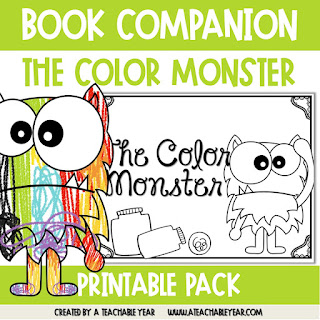
My The Color Monster Book Companion extends the story with activities focused on emotions, emotional vocabulary, comprehension, sequencing, feelings identification, social-emotional learning, and hands-on extensions inspired by the colorful world of the story.
Children can explore the different emotions while practicing important early literacy skills, developing vocabulary, making personal connections, and learning simple ways to recognize and communicate their feelings.
The goal isn't simply to teach children the names of six emotions.
It's to help them develop a language they can use when they need it.
The Power of Giving Feelings a Name
One of the simplest and most powerful things we can give young children is vocabulary.
A child who can say:
"I'm angry."
has more information to work with than a child who can only scream.
A child who can say:
"I'm scared."
can begin to ask for help.
A child who can say:
"I'm sad because I miss my mom."
can communicate a need.
A child who can say:
"I need some quiet time."
is beginning to recognize what might help.
Naming an emotion doesn't make it disappear.
But it can make the emotion less confusing and easier to communicate.
And that is one of the beautiful ideas at the heart of The Color Monster.
Final Thoughts
Some books teach children their colors.
Some books teach children about feelings.
The Color Monster does both.
But perhaps its greatest gift is giving children a simple way to begin talking about the complicated world inside them.
Sometimes we feel happy.
Sometimes we feel sad.
Sometimes we feel angry.
Sometimes we feel afraid.
Sometimes we feel calm.
Sometimes we feel love.
And sometimes...
we feel many things at once.
We don't need to be afraid of those feelings.
We can notice them.
We can name them.
We can talk about them.
We can ask for help.
And we can learn that every emotion has a place.
Because helping children understand their feelings isn't about making sure they are happy all the time.
It's about helping them develop the words, awareness, and confidence to say:
"This is how I feel."
And perhaps that's one of the most important things we can teach them.



0 Comments:
Post a Comment
Thanks for your comment!