

There is something special about watching a child step inside a story.
Not through a screen.
Not through a worksheet.
But through their hands.
A handful of beans becomes a forest path. Wooden slices become stepping stones. A toy character becomes the beginning of a new adventure.
This is the beauty of book-based sensory bins.
By combining rich literature with open-ended sensory play, we create opportunities for children to explore stories in a way that feels meaningful, engaging, and developmentally appropriate.
What Is a Book-Based Sensory Bin?
A book-based sensory bin is a simple invitation inspired by a story.
After reading a favorite book, children are offered materials that reflect the characters, setting, themes, or events within the story. These materials invite them to revisit the book through exploration, imagination, and play.
A forest-themed bin might extend The Gruffalo.
A nature-inspired tray filled with colorful trees and loose parts might bring The Lorax to life.
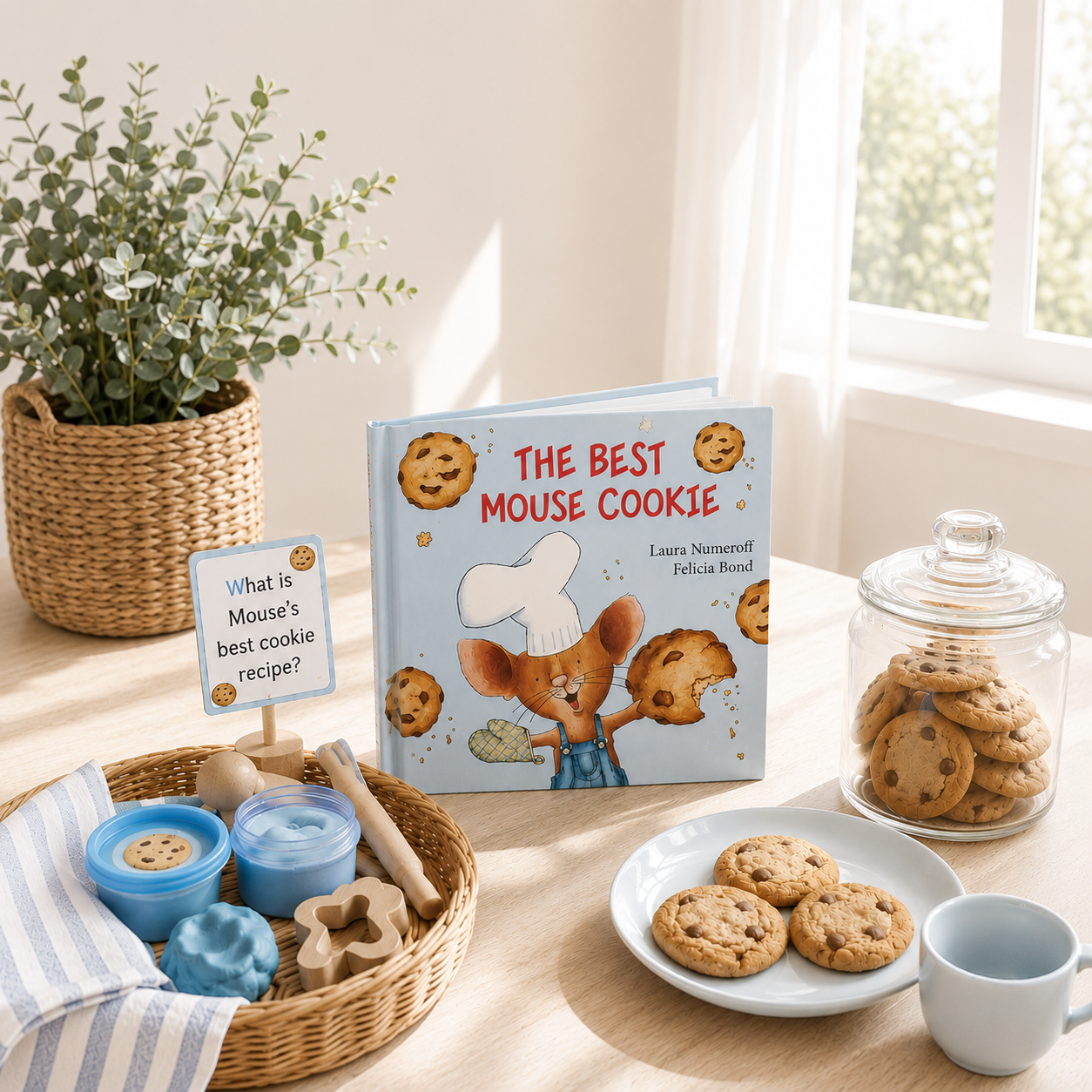
A cookie-themed sensory setup can encourage children to retell If You Give a Mouse a Cookie.
A pancake sensory bin can transform Mr. Wolf's Pancakes into a hands-on learning experience.
The goal isn't to recreate the story perfectly.
The goal is to create space for children to interact with it in their own way.
Why Sensory Play Matters
Young children learn best when they can engage multiple senses.
They learn through touching.
Pouring.
Scooping.
Sorting.
Building.
Moving.
Sensory play provides opportunities for children to slow down, investigate, and make discoveries at their own pace.
When sensory experiences are connected to meaningful literature, children are able to deepen their understanding of the story while developing important foundational skills.
Learning Happens Naturally
One of my favorite things about sensory bins is that learning unfolds organically.
Children may begin by exploring the materials, but before long they are making connections, solving problems, and creating stories of their own.
Through book-based sensory play, children naturally practice:
- Language and vocabulary development
- Story retelling and comprehension
- Sequencing events
- Fine motor skills
- Problem-solving
- Creative thinking
- Social interaction and collaboration
- Sensory exploration
Most importantly, they are building a personal connection to the story.
Beyond Retelling
While sensory bins are wonderful for story retelling, they often become something more.
Children may invent new adventures for familiar characters.
They may create different endings.
They may introduce new ideas, questions, and perspectives that were never part of the original story.
This kind of imaginative thinking is where some of the richest learning happens.
The story becomes a starting point rather than a destination.
Simple Can Be Meaningful
Book-based sensory bins do not need to be elaborate to be effective.
A handful of natural materials.
A favorite picture book.
A few character pieces.
An invitation to explore.
That is often enough.
Children don't need perfectly themed setups or dozens of materials. What they need is time, space, and the freedom to engage with a story in a way that feels meaningful to them.
Bringing Stories to Life
Stories help children understand the world.
Sensory play helps them experience it.
When we combine the two, we create opportunities for deeper engagement, stronger comprehension, and joyful learning.
A story no longer stays on the page.
It moves into children's hands.
Into their conversations.
Into their imaginations.
And often, those moments become the ones they remember long after the book is closed.
Because sometimes the most meaningful learning begins with a story and grows through play.



0 Comments:
Post a Comment
Thanks for your comment!